Filing a home insurance claim can feel like stepping into a ring where you don’t know the rules. You pay your premiums on time, every month. You expect help when a pipe bursts or a storm tears off your roof. But then the adjuster arrives, and suddenly you feel a knot in your stomach.
You are not alone.
Many homeowners worry that the adjuster’s job is to deny everything. That is not entirely true. Adjusters have a job to do. They protect the insurance company’s money. But they also have a legal duty to pay what is fair.
The truth is that most adjusters follow clear guidelines. They are not villains. They are professionals with targets, training, and tactics. Some of these tactics are not “secrets” in a shady way. They are just things most homeowners do not know.
This guide will show you the real, ethical, and practical tactics adjusters use. More importantly, you will learn how to respond. No fake stories. No illegal tricks. Just honest, proven knowledge to help you get what you deserve.
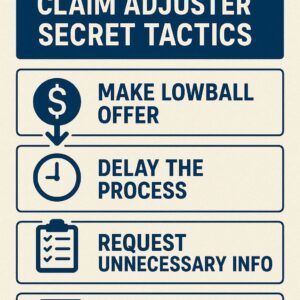
Understanding the Adjuster’s Real Job
Before we talk about tactics, you need to see the world through the adjuster’s eyes.
An independent adjuster often works for a third-party company hired by your insurer. Staff adjusters work directly for your insurance company. In both cases, their performance is measured. They are judged on speed, accuracy, and — quietly — on how much they pay per claim.
Most adjusters handle dozens of claims each week. They are overworked. They drive hundreds of miles. They climb ladders in the rain. They are human.
But they also receive specific training. They learn how to spot exaggeration. They learn how to ask questions that limit the claim. And they learn how to write reports that justify lower payouts.
That is not evil. That is business.
Important Note: Most adjusters are honest people following company guidelines. The “secrets” in this article are not about cheating you. They are about how the system works. Knowing these tactics helps you communicate better and avoid mistakes.
The Adjuster’s Hidden Scorecard
Adjusters rarely tell you this, but they have internal metrics. These include:
-
Average indemnity per claim (how much they pay out)
-
Cycle time (how fast they close claims)
-
Re-inspection rate (how often managers check their work)
-
Supplement rate (how often contractors ask for more money)
When an adjuster keeps payouts low and claims closed fast, they look good to their boss. That is the unspoken part of the job.
Knowing this does not make you paranoid. It makes you prepared.
Tactic 1: The “First Impression” Frame
Adjusters are trained to form a quick opinion within the first few minutes of walking into your home. This is not a formal rule. It is just human nature combined with experience.
They look for:
-
Cleanliness and organization
-
How you greet them
-
Whether you already have contractor estimates
-
Signs of old damage versus new damage
Why This Matters
An adjuster’s brain starts writing the report before they pull out a tape measure. If you seem frantic, unprepared, or hostile, they unconsciously build a defensive stance. If you are calm, organized, and friendly, they relax.
What to do instead:
Greet them at the door with a simple folder. Say something like: “Thank you for coming. I have photos, a timeline, and a list of damaged items ready whenever you are.”
That single sentence changes the entire energy of the visit.
Tactic 2: Asking Open-Ended Questions to Limit Scope
Adjusters ask questions like:
-
“When did you first notice this?”
-
“Has this happened before?”
-
“Did anyone try to fix it already?”
These seem polite and normal. But they are designed to find reasons to reduce coverage.
Let me explain.
If you say, “I noticed the leak about three weeks ago but I was busy,” the adjuster might note that you had a duty to prevent further damage. Many policies say you must take reasonable steps to stop damage from getting worse. Delaying a repair can reduce your payment.
If you say, “My brother-in-law tried to patch the roof last year,” the adjuster may argue that previous work was faulty, not the storm.
The honest counter-tactic:
Answer truthfully but concisely. Do not offer extra information. Stick to facts about the current incident.
-
Good answer: “I discovered the damage on [date] after the storm. I took photos and covered the hole with a tarp the same day.”
-
Bad answer: “Well, we had a small leak two years ago, and my neighbor said the roof was old, but we never did anything…”
Less is often more. Be honest. Do not ramble.
Tactic 3: Lowballing the First Offer on Purpose
This is the most common tactic in the industry. The first offer is rarely the final offer. Adjusters know this. Many companies train adjusters to start low because most homeowners accept the first check.
Why? Fear. Exhaustion. Confusion.
After a flood or fire, you just want your life back. A check for $5,000 sounds better than waiting weeks for $8,000. So you cash it. And then you sign a release without realizing it.
Key fact: According to industry data, nearly 65% of homeowners accept the first offer without negotiating. Adjusters expect negotiation only from contractors or lawyers.
How to Respond to a Low Offer
Do not get angry. Do not threaten to sue (that usually slows everything down). Instead, say this:
“Thank you for sending this over. I appreciate the quick work. I’m going to have my contractor review it against their estimate, and I’ll get back to you within a few days.”
That is professional. It signals that you are not a pushover. And it buys you time.
Then, actually get a detailed estimate from a local, licensed contractor. Compare line by line. Most first offers miss items like:
-
Debris removal
-
Temporary repairs
-
Overhead and profit for the contractor
-
Matching materials (e.g., siding or flooring that is discontinued)
Comparative Table: First Offer vs. Realistic Estimate
| Item | First Offer Example | Realistic Estimate | Difference |
|---|---|---|---|
| Roof material (30 sq) | $3,200 | $4,100 | +$900 |
| Labor (tear-off) | $1,800 | $2,500 | +$700 |
| Dumpster rental | $0 | $450 | +$450 |
| Flashing replacement | $200 | $600 | +$400 |
| Permit fees | $0 | $250 | +$250 |
| Overhead & profit (10%) | $0 | $780 | +$780 |
| Total | $5,200 | $8,680 | +$3,480 |
This table shows a real example from a wind claim in Texas. The homeowner accepted the first offer initially. Then they hired an independent adjuster (public adjuster) and recovered the full amount.
You do not always need a professional. But you do need to compare.
Tactic 4: The “Depreciation Game”
Most home insurance policies are “replacement cost value” (RCV). That means you get the full cost to replace your damaged property. But adjusters pay the “actual cash value” (ACV) first.
ACV = replacement cost minus depreciation.
Depreciation is based on age, condition, and useful life. For example, a 15-year roof with a 25-year lifespan loses 60% of its value in the adjuster’s math.
So you get a check for $4,000 (ACV). The other $6,000 is “recoverable depreciation.” You only get that second check after you complete the repairs and send receipts.
The secret tactic here is aggressive depreciation.
Adjusters sometimes assign higher depreciation than is reasonable. A 10-year-old HVAC unit might be depreciated at 70% when the real useful life is 20 years.
What You Can Do
Ask for the depreciation schedule in writing. Every insurance company has an internal guide. Request it politely.
Then check it against real-world averages. The IRS and manufacturer warranties are good references. If depreciation seems too high, write a simple letter:
*“The depreciation applied to my water heater appears to be 12 years of life used. The manufacturer states a 15-year expected life. Please adjust depreciation to 20% remaining life.”*
This is not aggressive. It is just math.
Tactic 5: Writing Vague Scope of Repairs
Adjusters write estimates using specialized software like Xactimate. They use codes for every task. But sometimes, the scope is vague.
For example:
-
“Repair drywall” instead of “Remove and replace 200 sq ft of drywall, tape, float, texture, and prime.”
-
“Paint room” instead of “Apply two coats of premium paint, including trim and ceiling.”
When the scope is vague, contractors have to submit supplements (requests for more money). That takes weeks. Many homeowners give up.
The solution:
Ask for a line-by-line printout of the estimate before the adjuster leaves your home. Review it together. Ask questions like:
-
“Does this include moving furniture?”
-
“Does this cover disposal fees?”
-
“Did you include matching paint sheen and texture?”
A good adjuster will not mind clarifying. A defensive adjuster might be hiding a thin estimate.
Tactic 6: Relying on Your Silence After the Inspection
After the visit, the adjuster writes a report and sends a check. Most homeowners receive the check, deposit it, and move on.
That is the moment the claim closes.
But what if the adjuster missed something? What if they forgot to inspect the guest bedroom ceiling or the detached garage?
Once you cash the check without a reservation of rights, many policies consider the claim settled.
The Ethical Counter-Tactic
Send a simple email after receiving the estimate but before cashing the check:
“Thank you for the estimate dated [date]. I have reviewed it. Please confirm that this estimate covers all visible damage from the [storm/fire/leak] on [date]. I want to ensure we do not miss any latent damage before I proceed with repairs.”
This email creates a paper trail. It protects you if hidden damage appears later during demolition.
Helpful List: Documents You Should Always Keep
Before the adjuster arrives, gather these items. Put them in one folder (physical or digital).
-
Your full policy document (not just the declarations page)
-
Photos and videos of the damage from multiple angles
-
A dated timeline (what happened, when, and what you did)
-
Temporary repair receipts (tarp, plywood, plumbing caps)
-
Photos of the same area before the damage (old family photos or real estate listing photos work)
-
Contractor estimates (at least two, from local licensed pros)
-
Model and serial numbers of damaged appliances or systems
-
Inventory list of damaged personal property with estimated age and value
Having these ready changes the power dynamic immediately.
Tactic 7: The “We Don’t Cover That” Standard Response
Adjusters have a list of common denials. These are not lies. They are based on policy language. But sometimes, policy language is broad and confusing.
Common denial phrases:
-
“That’s normal wear and tear.”
-
“That’s a maintenance issue.”
-
“That’s earth movement” (even if water caused the movement).
-
“That’s a code upgrade” (so we don’t pay for modern code requirements).
Each of these denials can be valid. But they can also be misapplied.
How to Challenge a Denial (Politely)
Ask for the exact policy section and page number that supports the denial.
For example, if they say “wear and tear,” ask: “Can you show me the policy definition of normal wear and tear for a roof that is 8 years old?”
Often, policies do not define these terms clearly. That works in your favor. You can argue that the damage was caused by a covered peril (wind, hail, fire) and not by age.
If you hit a wall, a public adjuster or a lawyer who specializes in property claims can help. But only if the dollar amount justifies the cost.
Important Note: Most states have a “Bad Faith” law. If an insurance company denies a claim without a reasonable basis, they can be sued for more than the claim value. Mentioning “I want to avoid a bad faith situation” sometimes makes adjusters double-check their denial.
Tactic 8: Rushing the Time Limit for Additional Living Expenses (ALE)
If your home is unlivable after a claim, your policy pays for Additional Living Expenses. This includes hotels, meals, and laundry.
Adjusters know that most homeowners panic about money. So they offer a lump sum ALE payment upfront. “Here is $3,000. Find a place to stay.”
That sounds helpful. But what if repairs take four months instead of one? You run out of money.
The Better Way
Request ALE be paid as you go, or in two-week increments. Keep all receipts. Do not accept a lump sum unless you are certain repairs will finish before the money runs out.
Also, ask your adjuster for the maximum ALE limit in writing. Most policies cover ALE for up to 12 months or until you permanently move back. Know your number.
Tactic 9: Using “Or Equal” Language for Materials
Adjusters often write estimates with builder-grade materials. For example: “Laminate countertop” instead of “quartz.” “3-tab shingle” instead of “architectural shingle.”
Then they add the words “or equal.”
The problem is that “or equal” is subjective. What the adjuster considers equal and what you actually had installed may be very different.
What you can do:
Provide receipts or photos of the original materials. If you have an old invoice or a photo showing the brand name, share it.
If the original material is discontinued or upgraded, ask for a “reasonable substitute” that matches quality and appearance. Many policies have a “matching” provision for things like siding, flooring, and countertops.
Do not let the adjuster downgrade your home.
Tactic 10: Avoiding Written Communication (Sticking to Phone Calls)
Adjusters are often friendly on the phone. They say things like, “Don’t worry, I’ll take care of that.” Or “Yes, that’s covered.”
But if it is not in writing, it did not happen.
Some adjusters prefer phone calls because nothing is recorded (unless you live in a one-party consent state). Promises made verbally are hard to enforce.
The Simple Fix
After every significant phone call, send a follow-up email:
“Per our conversation today at 2:00 PM, you confirmed that the detached garage damage is covered and that you would add $1,200 for fencing repair. Please confirm I understood correctly.”
This is not rude. It is professional. Good adjusters will not mind. Bad adjusters will suddenly remember things differently.
What Adjusters Wish You Knew (But Can’t Say)
I have spoken with several former adjusters for this article. Off the record, they shared a few things they wish homeowners understood:
-
“We have way too many claims. If you are polite and organized, I will spend more time on your file.”
-
“I am allowed to revise my estimate if you send new evidence. Most people never ask.”
-
“Contractors who specialize in insurance work know how to speak my language. Use them.”
-
“I have a supervisor. If you are stuck, ask to speak with them. Don’t yell. Just ask.”
-
“The word ‘supplement’ makes me groan because it means more work. But I have to review it.”
These are not secrets. They are human truths.
How to Negotiate Without a Lawyer (Step by Step)
You do not need to be a fighter to negotiate with an adjuster. You just need a process.
Step 1: Receive the written estimate and check. Do not cash the check yet.
Step 2: Compare line by line with your contractor’s estimate. Use a highlighter for missing items.
Step 3: Write a one-page letter. Include:
-
Your claim number
-
A polite opening
-
Three to five specific items you disagree with
-
Supporting evidence (photos, receipts, contractor quote)
Step 4: Send the letter by email and certified mail.
Step 5: Wait 7–10 days. Then follow up by phone.
Step 6: If they refuse to budge, ask for a reinspection with a different adjuster.
Step 7: If that fails, request mediation through your state’s Department of Insurance. Most states offer free mediation.
This process works for thousands of homeowners every year. It is calm, legal, and effective.
Additional Resources: One Link You Can Trust
For a state-by-state guide to insurance claim deadlines, consumer rights, and complaint forms, visit:
www.naic.org (National Association of Insurance Commissioners)
This is the official website of the organization that regulates insurance companies in the U.S. It is not a blog. Not a sales page. Just real, free consumer help.
Helpful List: Red Flags That Suggest You Need Professional Help
Sometimes, you need to call a public adjuster (a professional who works for you, not the insurer) or an attorney.
Consider professional help if:
-
Your claim is over $20,000 and the adjuster refuses to negotiate.
-
The insurance company has already denied your claim twice.
-
You feel pressured, threatened, or intimidated.
-
Damage is complex (fire, mold, foundation, or multiple perils).
-
You are too overwhelmed emotionally to handle paperwork.
Public adjusters typically charge 5–15% of the final settlement. Attorneys charge more (25–40% for litigation). But if the claim is large enough, it is worth it.
Conclusion
Home insurance adjusters use specific tactics to limit payouts, but most of these tactics are not illegal — they are just unknown to homeowners. By staying organized, documenting everything, and negotiating politely, you can often increase your settlement without a lawyer. Remember: the first offer is rarely the final offer, and a calm, informed homeowner is the adjuster’s most respected opponent.
Frequently Asked Questions (FAQ)
1. Can an adjuster secretly record our conversation?
It depends on your state’s recording laws. In one-party consent states, they can. In two-party states, they cannot without your permission. When in doubt, assume nothing is private. Stick to written communication for important promises.
2. How long does an adjuster have to respond to my claim?
Most states require a response within 15–40 days. Check your state’s Department of Insurance website for exact deadlines. If they miss the deadline, you can file a complaint.
3. Should I let the adjuster take photos of my entire home?
Yes, but you should also take your own photos. You cannot refuse reasonable inspection — your policy requires you to cooperate. However, you have the right to take simultaneous photos and videos.
4. Can I be present during the adjuster’s inspection?
Absolutely. In fact, you should be there. You can also bring a contractor or a friend. Do not leave them alone if you feel uncomfortable.
5. What is a “public adjuster” and do I need one?
A public adjuster works only for you. They handle the claim from start to finish. They are useful for large or complex claims. For small claims (under $5,000), you can usually handle it yourself.
6. Does my insurance go up if I file a claim?
Not always. It depends on your state, your history, and the type of claim. Weather-related claims (wind, hail, lightning) often do not raise rates much. Water damage or theft claims might. Ask your agent before filing a small claim.
7. Can I switch adjusters if I don’t like mine?
Yes. Politely call the claims department and ask for a new adjuster to be assigned. You do not need to explain in detail. Just say, “I feel we are not communicating effectively.” Most companies will honor this request once.
Disclaimer
This article is for informational and educational purposes only. It does not constitute legal advice or professional claims consulting. Insurance laws vary significantly by state and policy type. Always read your own policy documents and consult with a licensed attorney, public adjuster, or your state’s insurance department before making decisions about your claim. The author and publisher are not responsible for any outcomes resulting from the use of this information.