You have just walked out to your car and found a deep scratch along the door. Or maybe a branch fell on your roof during a storm. Your first thought is about the insurance claim. Your second thought is: Do I need to call the police?
It is a common question, and the answer is not always a simple yes or no.
The truth depends on what happened, who is involved, and which type of claim you plan to file. In some situations, a police report acts like gold for your case. In others, it is completely unnecessary.
Let us walk through every scenario together. By the end of this guide, you will know exactly when to pick up the phone and when to simply file your claim online.
Why Insurance Companies Ask for Police Reports
Before we get into specific situations, it helps to understand why your insurer might want a police report in the first place.
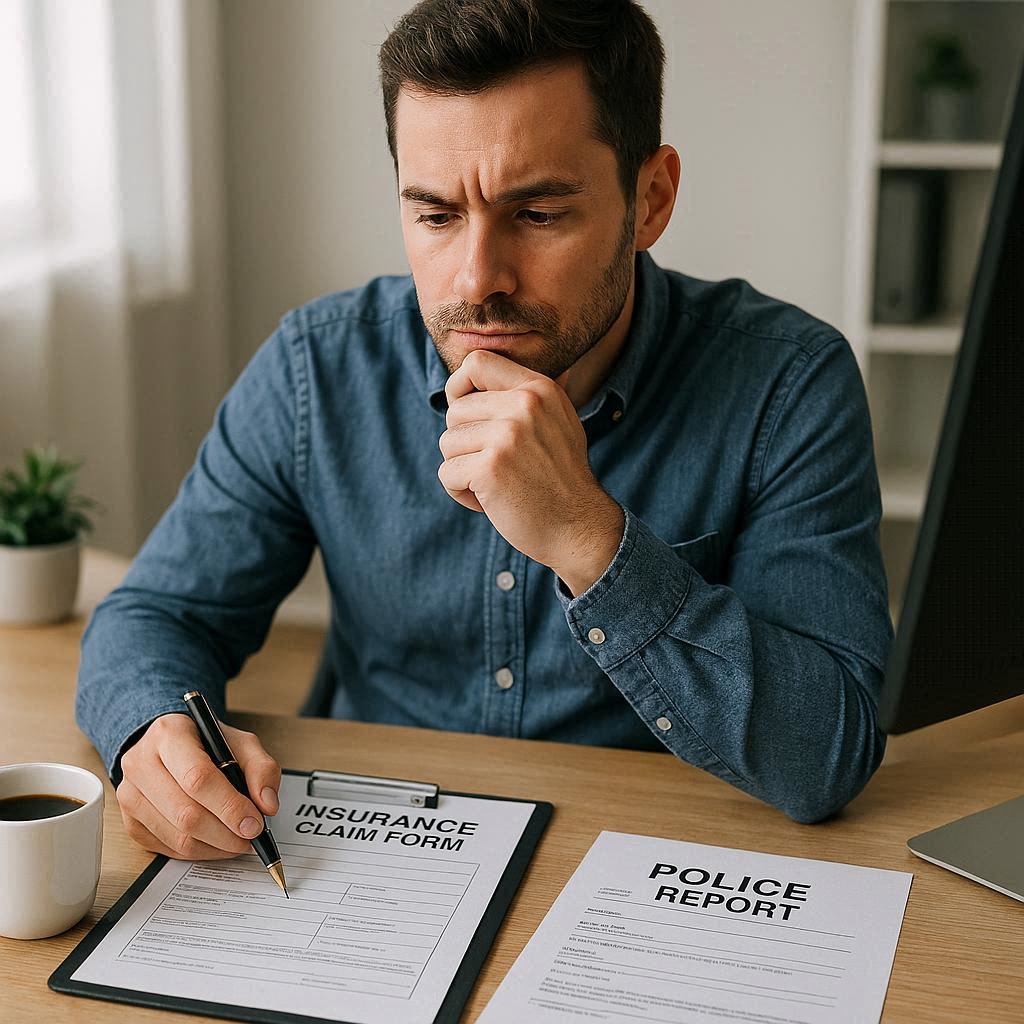
Insurance companies love documentation. They operate on facts, dates, and official records. A police report serves as a neutral, third-party account of an incident. It provides:
- An official timestamp of when the event happened
- A factual description of the damage or loss
- The names and statements of witnesses or other parties
- A legal record in case of fraud or dispute
When an insurer sees a police report, they feel more confident paying out your claim quickly. Without one, they have to rely only on your word. And while most people are honest, insurance companies prepare for the few who are not.
Important Note: Not every claim needs a police report. But having one never hurts your case. It only adds credibility.
The Short Answer: It Depends on the Incident
Here is the honest bottom line.
You typically do need a police report if:
- Another driver was involved in a car accident
- Your vehicle was hit while parked (hit-and-run)
- Your car or personal property was stolen
- Vandalism caused the damage
- Someone was injured
- There is a dispute about who caused the damage
You typically do not need a police report if:
- Your car hit a stationary object (like a pole or garage wall)
- Weather damaged your home or car (hail, wind, falling tree)
- An animal ran into your vehicle
- Your phone or laptop broke accidentally at home
- Minor scratch or dent with no other party involved
Let us break each of these categories down in detail.
Car Insurance Claims: When a Police Report Is Required
Auto insurance is where police reports matter the most. This is because car accidents often involve legal liability. Someone has to be at fault. And the police officer acts as a neutral witness to the facts.
Accidents with Another Driver
If two or more cars collide, you should always call the police. Even for a minor fender bender.
Here is why.
The other driver might change their story later. They might tell their insurance company that you were speeding or that you ran a red light. Without a police report, it becomes your word against theirs. And insurance companies often side with the driver who has an official document.
A police report notes:
- The date, time, and exact location
- Statements from both drivers
- Witness contact information
- Weather and road conditions
- Any citations issued
- A diagram of how the accident happened
Insurers rely heavily on these details. In many states, you cannot even file a claim for a multi-vehicle accident without a police report number.
Hit-and-Run Incidents
This scenario happens more often than you think. You park your car at the grocery store. You come back ten minutes later. Someone has slammed into your bumper and disappeared.
Yes, you need a police report for a hit-and-run claim.
Without a report, your insurance company has no way to verify that another driver caused the damage. You could have backed into a pole and then claimed a hit-and-run. Insurers know this. So they require official documentation.
The police will come to the scene, take photos, and look for paint transfer or security cameras. They will create a report that your insurer can use to process your claim under your uninsured motorist coverage or collision coverage.
Theft of Your Vehicle
If your car is stolen, call the police immediately. This is non-negotiable.
You cannot file a theft claim without a police report. The insurance company needs proof that law enforcement knows about the theft. They also need the report number to flag your vehicle in national databases.
When your car is recovered — sometimes weeks or months later — the police report helps determine its condition and any damages that happened during the theft.
Vandalism
Someone keyed your car. Spray-painted your fence. Smashed your mailbox with a baseball bat.
This is criminal mischief. And your insurance company will ask for a police report before they pay for repairs.
Why? Because vandalism is a crime. Insurers want to see that you reported the crime to authorities. It also helps them track patterns in your neighborhood. If vandalism is common in your area, they might adjust your premiums or recommend security measures.
Car Accidents with Injuries
If anyone is hurt — even a minor complaint of neck pain — call 911 immediately.
Injuries change everything. Your insurance claim will include medical payments, lost wages, and potentially a lawsuit. A police report becomes a legal document that can be used in court.
The responding officer will document the injuries, note who complained of pain, and sometimes call an ambulance. That record is essential for your claim and for protecting you if the other driver decides to sue.
Home Insurance Claims: Do You Really Need a Police Report?
Homeowners and renters insurance handle police reports differently. In many cases, you do not need one. But there are specific exceptions.
Theft of Personal Property
Someone broke into your home and stole your laptop, jewelry, and television.
You need a police report.
Home insurance companies require proof that a crime occurred. Without a report, they might suspect you are trying to commit fraud or simply lost the items. A police report provides an official record of the break-in, including the date, method of entry, and list of stolen goods.
File the report before you call your insurer. Have the report number ready when you start your claim.
Vandalism to Your Home
Graffiti on your garage door. A smashed window from a thrown rock. Damage from someone intentionally kicking in your fence.
Yes, you need a police report for vandalism claims on your home. The same logic applies as with car vandalism. It is a crime. Your insurer needs proof that you treated it as one.
Burglary vs. Theft
Here is a small but important difference.
If someone steals your phone from your bag while you are at a coffee shop, that is theft. You can usually file a renters insurance claim without a police report, though having one still helps.
If someone breaks a lock to enter your home and takes your phone, that is burglary. You definitely need a police report.
Insurance companies view burglary as more serious. They want law enforcement involved.
Damage from a Storm, Fire, or Water
A tree falls on your roof. A pipe bursts in your basement. A lightning strike causes an electrical fire.
You do not need a police report for any of these.
These are acts of nature or accidental failures. No crime occurred. The police cannot add anything useful to your claim. Call your insurance company directly and document everything with photos and videos.
Reader Tip: After a storm, focus on taking clear photos of the damage from multiple angles. That evidence matters more to your insurer than a police report.
Disappeared Items (No Sign of Break-In)
Sometimes things just vanish. Your wedding ring falls off your nightstand. Your tablet disappears after a party. You cannot find your camera anywhere.
Without evidence of a crime, a police report will not help. Most departments will not even take a report for missing items without signs of forced entry.
In this case, your insurance claim depends entirely on your own documentation. Receipts, photos of you wearing the item, and written statements matter more than any police report.
Special Cases: When You Really Have to Decide Fast
Some situations fall into a gray area. Here is how to handle them.
Your Car Was Hit While Parked, and You Found a Note
This happens often. You return to your car and see a handwritten note on the windshield. “Sorry I hit your car. Here is my number.”
First, take photos of the note, your damage, and the surrounding area. Then call the police non-emergency number.
Ask if they will send an officer to create a report. In some cities, they will. In others, they will tell you to file a report online or at the station.
Either way, get an official report number. It protects both you and the person who left the note. It prevents them from changing their story later.
The Other Driver Wants to Settle Without Insurance
You get into a small fender bender. The other driver says, “Let’s not get insurance involved. I will pay cash for your repairs.”
This is risky. But if you choose to do it, you should still get a police report.
Wait. That sounds contradictory.
Here is the safe approach: Call the police, get the report, and then decide not to file an insurance claim. The report protects you if the other driver refuses to pay later. It gives you the option to file a claim retroactively.
Do not let a friendly driver talk you out of official documentation. Polite words do not pay for bodywork two weeks later.
The Police Refuse to Come to the Scene
In many large cities, police no longer respond to minor car accidents with no injuries. They tell you to file a “self-report” online or at the local precinct.
This is becoming very common.
If this happens, do not panic. Go to the police department’s website. Look for the “collision report” or “citizen accident report” form. Fill it out completely. Attach your photos. Submit it.
Then keep the confirmation number or printed copy. Your insurance company will accept this as a valid police report for claim purposes.
Step-by-Step: How to Get a Police Report for an Insurance Claim
Let us make this practical. If you decide you need a police report, here is exactly how to get one.
Step 1: Call the Right Number
- For emergencies or injuries: Call 911
- For active disputes: Call 911
- For non-emergency damage: Call the local police non-emergency number
- For hit-and-run: Call 911 immediately
Step 2: Stay Calm and Gather Information
While you wait for the officer, collect:
- Your driver’s license and insurance card
- The other driver’s license plate and insurance (if applicable)
- Photos of all damage from multiple angles
- Photos of the overall scene
- Contact information for any witnesses
- A written note of what happened in your own words
Step 3: Speak Clearly to the Officer
When the officer arrives, stick to facts. Do not guess. Do not exaggerate. Do not admit fault.
Say: “I was driving north on Main Street. The other car turned left from Elm Street and hit my front passenger side.”
Do not say: “They came out of nowhere and I think they were speeding.”
The officer will write their report based on your words. Keep it simple and honest.
Step 4: Get the Report Number
Before the officer leaves, ask for:
- The incident or report number
- The officer’s name and badge number
- The precinct handling the report
Write this information down. Officers deal with many incidents. They might forget to give it to you.
Step 5: Obtain the Full Report
Police reports are not always ready immediately. Most take 3 to 10 business days. Some are available online. Others require an in-person visit to the records department.
Call the precinct after five days. Ask how to get your copy. There is often a small fee — usually $10 to $25.
Once you have the report, read it carefully. Check for errors in dates, names, or descriptions. Mistakes happen. Correct them immediately.
The Consequences of Not Having a Police Report
What happens if you skip the police report entirely?
The answer depends on your claim. But here are real consequences that policyholders face.
Claim Denial
For theft, vandalism, hit-and-run, and multi-vehicle accidents, your claim can be denied outright without a police report. The insurer will say: “You did not follow the required steps to verify this incident.”
This is legal. It is written in most policies.
Delayed Payout
For claims that do not strictly require a report, the process will still take longer. The insurance company will ask more questions. They will request additional evidence. They might send an investigator to your home or business.
What could take one week might take six weeks or more.
Reduced Settlement
Without an official report, the insurer might only cover a percentage of your damages. They will argue that you cannot prove the extent of the loss. They might offer a “goodwill payment” well below your actual costs.
You can fight this, but it is an uphill battle without a police report.
Legal Vulnerability
If the other driver later sues you, a missing police report leaves you exposed. The court will have no neutral record of what happened. The other driver’s word might carry more weight simply because they filed a report and you did not.
When You Can File Without a Police Report (With Confidence)
Let us balance this out. Many claims go smoothly without any police involvement.
Here are examples where you can skip the report and feel good about it.
Single-Car Accident
You back into a concrete pillar in a parking garage. You scrape your side mirror against your own fence post. You hit a curb and damage your wheel.
No police report needed.
These are collision claims with no other party. Your insurance company only needs your statement and photos.
Animal Strike
A deer jumps in front of your car. A dog runs into the road. A bird crashes into your windshield.
Call your insurer, not the police. Animal strikes fall under comprehensive coverage. Police do not investigate wildlife accidents unless someone is hurt.
Take photos of the animal and the damage. That is your evidence.
Weather Damage
Hail dents your hood. Wind blows shingles off your roof. A flood damages your basement.
No police report. Call your insurer immediately. Use your phone to take date-stamped photos and videos. That is all you need.
Broken Personal Items
You drop your phone in the toilet. You sit on your glasses. You spill coffee on your laptop.
These are accidental damage claims under renters or homeowners policies. They have nothing to do with crime. A police report would be irrelevant.
Minor Mystery Damage
You wake up and notice a small dent in your garage door. You have no idea how it got there. No signs of vandalism or theft.
You can file this claim without a police report. Your insurer might still ask questions, but a report is not required for vague, minor damage.
The Hidden Benefit of Police Reports (Even When Not Required)
Here is something most articles do not tell you.
A police report helps fight fraud accusations.
Insurance fraud is a massive problem. Companies spend millions investigating suspicious claims. If your claim looks unusual in any way — high value, recent policy change, unclear cause — you might trigger a red flag.
A police report shuts down many of those concerns. It tells the insurer: “A neutral third party already looked at this and found no reason for suspicion.”
Even for claims that do not require a report, getting one can speed up your payout and reduce stress. You never lose anything by having more documentation.
What If the Incident Happened Days or Weeks Ago?
You discovered damage late. Maybe you did not notice the scratch on your car for three days. Maybe you just realized your watch is missing after a house party last weekend.
Can you still get a police report?
Yes. But it is different.
You will need to file a “delayed report” at your local police station. You cannot call an officer to the scene because the scene is gone. Instead, you go to the records department or front desk.
Be honest about when you discovered the loss. The officer will ask why you waited. A simple answer is fine: “I did not notice the damage until today” or “I thought I had misplaced the item at first.”
The resulting report carries slightly less weight because there is no immediate evidence at the scene. But it is far better than having no report at all.
A Comparison: Claims With vs. Without a Police Report
Let us put this side by side so you can see the difference clearly.
| Factor | With a Police Report | Without a Police Report |
|---|---|---|
| Claim approval speed | Fast (3-7 days) | Slow (2-8 weeks possible) |
| Risk of denial | Very low | Medium to high |
| Evidence required | Minimal beyond the report | Extensive photos, receipts, statements |
| Dispute protection | Excellent | Poor |
| Insurance fraud suspicion | Very low | Elevated |
| Your stress level | Low | High |
This table applies mainly to car theft, vandalism, hit-and-run, and multi-vehicle accidents. For weather damage or single-car accidents, the difference is much smaller.
Real Examples: How This Plays Out in Real Life
Let me share three realistic stories. They are fictional but based on thousands of real claims.
Example 1: The Smart Move
Maria returns to her car after dinner. The rear bumper is crushed. No note. No witnesses.
She calls 911 immediately. An officer arrives in 20 minutes. He takes photos, checks for security cameras, and writes a report. Maria gets the report number before going home.
She files her hit-and-run claim the next morning. The insurance company pays for the full repair within eight days. Her deductible is waived because the report clearly shows a hit-and-run.
Example 2: The Costly Mistake
James discovers a long key scratch on his car door. He is frustrated but does not call the police. He thinks it is not a big deal.
He files a vandalism claim online. The insurance adjuster calls and asks for the police report number. James has none.
The claim is put on hold for three weeks. An investigator calls James for a recorded statement. He asks why James waited. He asks if James has any enemies. He asks to see parking lot security footage.
Eventually, the claim is approved for only 70% of the repair cost. The insurer cites “insufficient third-party verification.” James pays the rest out of pocket.
Example 3: The Gray Area
Carlos hits a deer on a dark country road. His car is drivable but damaged. He calls his insurance agent, who says no police report is needed.
Carlos takes 15 photos of the deer, the car, and the road. He files his claim the next day. The claim is approved in 48 hours.
No police report. No problem. Because the situation never required one.
Frequently Asked Questions (FAQ)
Here are the most common questions readers ask about police reports and insurance claims.
Does a police report automatically mean my insurance will pay?
No. A police report helps verify what happened, but your policy still applies. If you only carry liability coverage, your insurer will not pay for your own car damage even with a perfect police report. Coverage comes first. Documentation comes second.
What if the police report gets something wrong?
This happens more often than you think. Officers are human. They make typos and misunderstand statements. If you find an error, contact the records department immediately. You can request an amendment or a supplemental report. Do not file your claim until the error is fixed, or the insurer will use the wrong information against you.
Can I file a police report online?
Many departments now offer online reporting for minor incidents. This includes:
- Vandalism under a certain dollar amount
- Theft of items under a certain value
- Hit-and-run with no injuries
- Lost property
Check your local police website. Online reports are valid for insurance claims.
Will my insurance rates go up if I file a police report?
The police report itself does not affect your rates. The claim does.
If you file a claim for an accident where you were at fault, your rates will likely increase. That is true with or without a report. If you file a claim for theft, vandalism, or a not-at-fault accident, your rates may stay the same.
The police report is just evidence. It does not cause rate changes.
How long do I have to file a police report for an insurance claim?
There is no universal deadline, but faster is always better.
- For car accidents: Within 24 hours is ideal. Some states require “immediate” reporting.
- For theft or vandalism: Within 48 hours.
- For discovered damage: Within a few days of discovery.
If you wait more than a week, expect extra questions and possible delays.
What if the other driver leaves before the police arrive?
Note their license plate if you can. Take a photo of their car driving away. Then call 911 and report a hit-and-run in progress. The dispatcher can alert patrol cars in the area. File your report the same day.
Do I need a police report for a stolen bicycle?
Yes, if you plan to claim it under renters or homeowners insurance. Most policies cover bicycles for theft, even outside the home. But you need a police report number. The insurer will verify the report before paying.
Can my insurance company get the police report themselves?
Sometimes. But do not rely on this.
Your insurer can request a copy, but it takes time. They will often ask you to provide it first. You are the policyholder. The responsibility to document your loss is yours.
Get the report yourself and upload it to your claim portal or email it to your adjuster.
Additional Resources You Can Use
Knowledge is power when dealing with insurance claims. Here are two highly useful resources.
1. National Insurance Crime Bureau (NICB)
The NICB helps consumers and insurers fight fraud. They offer a free VINCheck service to see if a used car has ever been reported stolen or damaged. They also publish guides on what to do after a crash.
Visit their website at nicb.org
2. Your State’s Department of Insurance
Every state has a Department of Insurance. These government agencies regulate insurance companies. They publish consumer guides, handle complaints, and explain your legal rights.
Search for “[your state] Department of Insurance” to find their website. Look for guides on “auto claims” or “homeowners claims” specific to your area.
A Quick Decision Guide
Use this simple flowchart in your mind when an incident happens.
Start here:
- Is there another person involved? → YES → Get a police report
- Is there a crime (theft, vandalism, hit-and-run)? → YES → Get a police report
- Is anyone injured? → YES → Get a police report (call 911)
- Is there a dispute about fault? → YES → Get a police report
- Was it weather, animal, or single-car accident? → NO → Police report optional
- Was it accidental damage to property? → NO → Police report not needed
When in doubt, make the call. A police report is free. A denied claim is expensive.
Conclusion
You need a police report for theft, vandalism, hit-and-run, and accidents involving another driver. You can skip it for weather damage, animal strikes, single-car accidents, and broken personal items. When you are unsure, always file the report — it only strengthens your insurance claim and protects you from disputes.
Disclaimer
This article is for general informational purposes only and does not constitute legal or professional insurance advice. Insurance policies, state laws, and police reporting requirements vary widely. Always consult your specific insurance policy and local law enforcement for guidance on your unique situation. The author and publisher assume no liability for any actions taken based on the information provided in this article.