Let’s be honest for a second. Health care costs in the United States can feel like a confusing maze. If you do not have health insurance, even a minor medical issue—like a stubborn sinus infection or a twisted ankle—can bring serious financial stress.
You might have a Kaiser Permanente facility near you. You are feeling unwell. You need help today, but you cannot wait for a primary care appointment. So, you consider urgent care.
But how much will it actually cost?
This guide provides a realistic, honest look at Kaiser urgent care cost without insurance. We will break down the prices, the hidden fees, the payment policies, and the smarter alternatives. No confusing medical jargon. Just the clear facts you need to make a smart decision.
Understanding the Difference: ER vs. Urgent Care vs. Kaiser Clinic
Before we talk about money, we need to clarify one crucial point. The price changes drastically depending on where you walk in.
- Emergency Room (ER): For life-threatening conditions (chest pain, severe bleeding, stroke symptoms). Extremely expensive ($1,500 – $3,000+ per visit).
- Kaiser Urgent Care: For moderate issues that need same-day attention but are not life-threatening (fevers, sprains, earaches, UTIs). Moderate cost.
- Kaiser Regular Clinic (Primary Care): For routine check-ups and non-urgent follow-ups. Usually cheaper than urgent care, but appointments take days or weeks.
If you lack insurance, urgent care is usually your “sweet spot.” It bridges the gap between the cheap (but slow) clinic and the expensive (but fast) ER.
Important Note: Kaiser Permanente is an integrated HMO system. This means their urgent care centers are designed for their members. However, most Kaiser locations do offer care to non-members (people without Kaiser insurance) on a “fee-for-service” basis. But always call ahead to confirm.
The Real Numbers: What is the Average Cost?
This is the question you came here for. Let’s look at the raw data.
For a patient without any health insurance paying out of pocket at a Kaiser Permanente urgent care facility (in 2025-2026), you are generally looking at two separate bills:
- The Facility Fee (The cost of walking in the door and using the room).
- The Professional Fee (The doctor or nurse practitioner’s time).
The Base Visit Fee
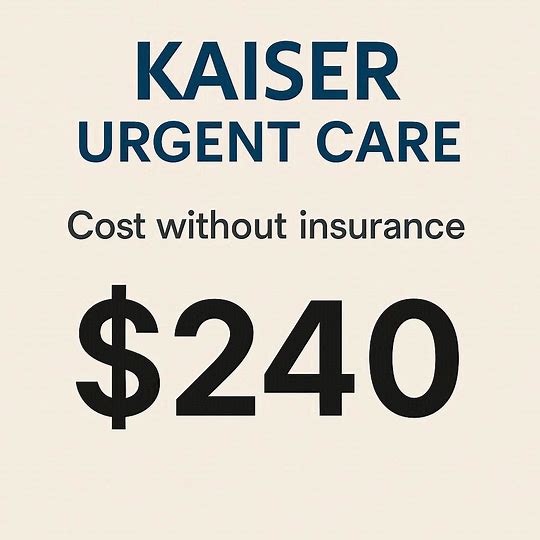
Most Kaiser urgent care visits without insurance cost between $150 and $350 just for the consultation. This covers the basic evaluation by a medical provider.
However, this is rarely the final number. The total final bill depends entirely on what the doctor does.
Cost Breakdown Table: Common Scenarios
To help you visualize the potential costs, here is a realistic breakdown based on regional averages (California, Colorado, Washington, DC, Maryland, Virginia, Oregon, Georgia, and Hawaii).
| Medical Issue | Base Visit Fee | Common Procedures/Tests | Estimated Total Cost (No Insurance) |
|---|---|---|---|
| Sore Throat / Strep Test | $150 – $200 | Rapid Strep Test ($25 – $50) | $175 – $250 |
| Urinary Tract Infection (UTI) | $160 – $220 | Urinalysis ($30 – $60) | $190 – $280 |
| Ear Infection (Otitis Media) | $150 – $200 | Otoscope exam (included) | $150 – $200 |
| Sprained Ankle (X-ray needed) | $160 – $220 | X-Ray (2 views – $100 – $200) | $260 – $420 |
| Stitches (Laceration repair) | $180 – $250 | Suturing supplies + numbing ($75 – $150) | $255 – $400 |
| Severe Allergy (Steroid shot) | $160 – $220 | Intramuscular injection ($25 – $60) + Meds | $185 – $280 |
A word of realism: If you need an X-ray, the price jumps significantly. If you need blood work (lab tests), you might see a separate bill weeks later from a third-party lab, even inside Kaiser. Always ask: “Is this test done here, and is the price included?”
The “Uninsured Discount” – Does Kaiser Offer It?
This is a very important detail. Unlike many hospital chains that charge “sticker price” (astronomically high rates), Kaiser Permanente has a reputation for being slightly more transparent with uninsured patients.
Most Kaiser regions offer a self-pay discount.
- How it works: If you tell the receptionist upfront, “I have no insurance. I am paying cash today,” they usually apply a reduced rate immediately.
- The discount range: Typically between 20% and 40% off the standard “billed” rate.
- The catch: You usually have to pay the full amount at the time of service (before you leave the urgent care) to qualify for the discount. If you ask to be billed later, you will likely pay the full, higher price.
Quotation from a Kaiser Financial Counselor (Hypothetical but realistic):
“If you are uninsured, your best financial move is to pay the estimated total before you walk out the door. We can apply the prompt-pay discount. If you wait for a bill in the mail, that discount disappears.”
Hidden Costs You Must Ask About
The “Kaiser urgent care cost without insurance” is rarely just one number. Savvy patients ask three specific questions before the doctor knocks on the door.
1. The “After-Hours” Surcharge
Urgent care is already for after-hours, but some Kaiser locations charge a higher facility fee on Sundays, holidays, or after 8:00 PM. This can add $25 to $75 to your bill.
2. The Supply Fee
A small bandage is free. But a splint, crutches, a sling, or a saline lock (IV) are not. These “consumables” often appear as a line item called “Medical/Surgical Supplies.” This can range from $10 to $150.
3. Lab Processing Fees
You go in for a UTI. The doctor sends your urine to an off-site lab. Two weeks later, you get a bill from “Kaiser Regional Lab” for $80. You thought you were done paying. Always ask: “Are you sending this to an external pathologist?”
Checklist: Questions to ask before treatment (No Insurance)
- “What is the base self-pay cash price for this visit?”
- “Does that price include the facility fee and the doctor’s fee?”
- “If I need an X-ray, what is the additional cost per image?”
- “If you order blood work or a urine test, is the analysis included in today’s price?”
- “Do you offer a financial assistance application for uninsured patients?”
Kaiser vs. The Competition: Price Comparison
Is Kaiser actually cheaper than other urgent care chains? Let’s look at a standard “Strep Throat” visit (Base + Test).
| Provider / Chain | Average Cost Without Insurance (Self-Pay) | Notes |
|---|---|---|
| Kaiser Permanente Urgent Care | $175 – $250 | Requires upfront payment for best rate. |
| CVS MinuteClinic | $89 – $139 | Cheaper, but limited to minor issues. No X-rays. |
| Walgreens VillageMD | $120 – $180 | Good for colds and flu. Not for injuries. |
| Concentra Urgent Care | $150 – $250 | Competitive, but focuses on occupational health. |
| Private ER (Hospital Campus) | $1,500 – $3,000 | Avoid unless dying. |
Analysis: Kaiser is in the middle of the pack. CVS is cheaper for a sore throat, but CVS cannot stitch a wound or cast a fracture. For true urgent care (X-ray, IV fluids, complex laceration), Kaiser’s price is fair for a hospital-integrated system.
Does Kaiser Offer Financial Assistance for the Uninsured?
Yes, but it is not automatic. You have to ask for it.
Kaiser Permanente is a non-profit health plan in many regions (California, Colorado, Oregon, etc.). As a non-profit, they are legally required to offer Charity Care or Financial Assistance to low-income patients, regardless of whether you are a member.
How to qualify for Kaiser Financial Assistance:
- Income threshold: Generally, if you earn less than 200% to 300% of the Federal Poverty Level (FPL). For an individual in 2026, that is roughly $30,000 to $45,000 per year.
- What it covers: Discounts from 50% up to 100% of the bill.
- How to apply: You cannot do this at the front desk. You must ask for a “Financial Assistance Application” or download it from the Kaiser website for your specific region (e.g., kp.org/financialassistance).
Crucial Warning: You usually have to apply within 90 to 240 days of receiving the service. Do not ignore the bill. Call the billing department and say, “I am uninsured and low-income. Please send me the charity care application.”
Payment Plans: Can You Pay Over Time?
If you cannot pay the $350 total today, Kaiser generally allows payment plans for uninsured patients.
- Standard plan: Usually 3 to 6 months interest-free.
- Long-term plans: For bills over $1,000, they may allow 12 months, but you have to negotiate.
- Down payment: They often require 20% to 30% down at the time of visit.
Pro-tip: Be polite with the billing representative. A friendly “I want to pay, but I genuinely cannot afford $350 today. Can I do $50 now and $50 monthly for 6 months?” works surprisingly well.
Alternatives to Kaiser Urgent Care (Cheaper Options)
If you see a $250 price tag and your heart sinks, you have other options. Do not skip medical care, but do not break the bank either.
Option 1: Retail Clinics (CVS, Walgreens, Walmart)
- Best for: Cough, cold, flu, pink eye, minor rashes, UTI screenings.
- Cost: $80 – $140.
- Weakness: No X-rays, no broken bones, no stitches.
Option 2: Telehealth (Virtual Visit)
Kaiser offers virtual urgent care, but so do dozens of apps (GoodRx Care, Sesame, Dr. B).
- Cost: $30 – $60 flat fee.
- Best for: Sinus infections, UTIs (uncomplicated), refill requests.
- Outcome: They send a prescription to your local pharmacy. You never leave your couch.
Option 3: Federally Qualified Health Centers (FQHCs)
- What they are: Community health centers funded by the government.
- Cost: Sliding scale (as low as $20 – $50) based on your income.
- How to find: Search “FQHC near me” or visit HRSA.gov.
- Weakness: They are usually busy. You might wait 2 hours to be seen.
Option 4: Direct Primary Care (DPC) Memberships
- How it works: You pay a monthly fee ($50 – $100/month) for unlimited visits to a specific small clinic.
- Value: If you get sick frequently, this saves you money. If you need urgent care once per year, it is not worth it.
Case Studies: Realistic Scenarios (Hypothetical but accurate)
Let’s put this knowledge into practice with three fictional but realistic uninsured patients visiting Kaiser Urgent Care.
Case 1: Sarah, 28 – Sore Throat
- Situation: Sarah has no insurance. She wakes up with white spots on her tonsils.
- Kaiser Visit: Base fee $180 + Rapid Strep Test $40.
- Total: $220.
- Result: Positive for Strep. Doctor sends a prescription for Amoxicillin to the Kaiser pharmacy.
- Pharmacy cost: $12 with a GoodRx coupon (Kaiser pharmacy accepts GoodRx for uninsured patients).
- Final out-of-pocket: $232.
Case 2: Mike, 45 – Rolled Ankle
- Situation: Mike stepped off a curb awkwardly. Ankle is swollen, cannot bear weight.
- Kaiser Visit: Base fee $200 + X-ray (2 views) $180.
- Total: $380.
- Result: No fracture. Diagnosis: severe sprain. Provider gives him an air cast (splint).
- Supply cost: Air cast + Ace bandage: $65.
- Final out-of-pocket: $445.
- Avoided cost: If Mike went to the ER, the bill would be $2,500+.
Case 3: Elena, 34 – Migraine & Vomiting
- Situation: Elena has a severe migraine and cannot keep water down for 12 hours.
- Kaiser Visit: Base fee $220. Provider recommends IV fluids and anti-nausea medication.
- Procedures: IV insertion ($75) + IV fluids ($60) + Toradol injection ($40).
- Total: $395.
- Result: Elena feels better after 2 hours. She pays $395 on her credit card. She asks for an itemized bill first and negotiates the IV supply fee down by $15.
How to Get an Itemized Bill (And Why It Matters)
If you receive a bill in the mail after your Kaiser urgent care visit (because you didn’t pay upfront), do not just pay it. Request an itemized bill.
An itemized bill lists every single charge: “Gauze: $8.00. Alcohol swab: $2.00. Medical waste disposal: $15.00.”
Why this helps: Hospitals and clinics frequently make billing errors. When you see a $25 charge for “sterile water,” you can call and ask *”Why am I paying $25 for tap water?”* Often, they remove those small nuisance charges just to close your account.
Script for calling Kaiser Billing:
*”Hello, my name is [Name]. I was seen at the urgent care on [Date] without insurance. I cannot pay the total amount shown. Could you please email me a fully itemized bill with all CPT codes? Also, please put my account on a 30-day hold while I review the charges.”*
Does Kaiser Urgent Care Prescribe Medication?
Yes, they do. But here is a money-saving secret.
If a Kaiser urgent care doctor prescribes you medication, you do not have to fill it at the Kaiser pharmacy. In fact, for uninsured patients, Kaiser pharmacy prices are often higher than retail.
Better strategy:
- Get the paper prescription (or digital send) from the doctor.
- Ask for the generic medication name.
- Open the GoodRx or SingleCare app on your phone.
- Search for the generic drug.
- Have the prescription sent to Costco, Walmart, or Safeway (who often have cheaper cash prices than Kaiser).
Example: A common antibiotic (Cefdinir) might cost $80 at Kaiser pharmacy. The same drug costs $15 at Costco with a GoodRx coupon.
Regional Differences (Kaiser by State)
Kaiser operates in only a few states, but the costs vary slightly based on local rent and wages.
- California (Northern & Southern): Highest costs. Expect to pay on the upper end ($200 – $400 total). High rent = high facility fee.
- Colorado: Moderate. ($150 – $300 total).
- Oregon & Washington (NW): Similar to Colorado. Moderate to high.
- Georgia: Lower. ($130 – $250 total). Labor is cheaper in the South.
- Maryland, Virginia, Washington D.C.: High. ($180 – $350 total).
- Hawaii: Very high. ($220 – $450 total). Limited alternatives on islands.
Note: Kaiser does not operate in Texas, New York, Florida, or Illinois. If you live there, this article does not apply to you.
What About Children? (Pediatric Urgent Care Cost)
If your child needs urgent care and you have no insurance, the cost structure is similar, but there is good news.
Kaiser, like most systems, charges by the room, not by the person (mostly). A child visit is typically the same base fee as an adult visit: $150 – $250.
However, pediatric procedures (like breathing treatments for croup) can add costs:
- Nebulizer treatment: +$50 – $100
- Ear lavage (wax removal): +$30 – $60
Parent tip: Many Kaiser regions offer a “Child Self-Pay Rate” for uninsured minors. Always ask explicitly: “Do you have a reduced rate for an uninsured child?”
Common Myths About Kaiser Urgent Care & Uninsured Patients
Let’s bust three common myths.
Myth 1: “Kaiser refuses to treat uninsured patients.”
Reality: False. Emergency rooms must treat you by law (EMTALA). Urgent care centers are not legally required to treat you, but most Kaiser urgent cares do treat uninsured patients as long as you sign a financial agreement to pay.
Myth 2: “If I don’t pay my Kaiser bill, it goes to jail.”
Reality: False. Medical debt is not a crime. It can go to collections and hurt your credit score, but you will not be arrested.
Myth 3: “Kaiser prices are the same for every uninsured person.”
Reality: False. Prices are negotiable. A patient who asks for a discount and pays cash today gets a lower price than a patient who says nothing and waits for the bill.
Negotiation Tactics: Yes, You Can Haggle
In the United States, medical bills are negotiable. This feels strange, but it is 100% true.
If your final Kaiser urgent care bill is $600 and you cannot pay it, follow these steps:
- Don’t ignore it. Call the billing number on the statement.
- Say this: “I am uninsured. This bill is unaffordable for my household. I can pay 40% of this total today via credit card if you agree to settle the account in full. Can you do that?”
- Wait. They will put you on hold. They often say yes to 50% – 60% settlements for uninsured patients because collecting 50% now is better than selling the debt to a collector for 10% later.
Realistic outcome: You can usually reduce a $500 urgent care bill to **$250 – $300** with a single 10-minute phone call.
Preparing for Your Visit: A Practical Checklist
To minimize the Kaiser urgent care cost without insurance, preparation is key.
Before you leave home:
- Call the specific Kaiser urgent care location. Ask: “Do you accept uninsured self-pay patients today?”
- Ask for the “cash price” estimate over the phone.
- Bring a form of ID (driver’s license or passport).
- Bring a credit card or debit card (they rarely accept cash for large amounts).
- Bring a list of your allergies and current medications.
During check-in:
- State clearly: “I have no insurance. I am a self-pay patient.”
- Ask: “Can I speak to a financial counselor before seeing the doctor?”
Before the doctor leaves the room:
- Ask: “What is the diagnosis code and CPT code for this visit?” (Write it down).
- Ask: “Are there any labs or follow-up tests that will generate a separate bill?”
The Future: Getting Insurance to Avoid Urgent Care Costs
The best way to lower your Kaiser urgent care cost without insurance is to get insurance. I realize that is obvious, but let me be specific.
If you earn between $15,000 and $60,000 per year, you likely qualify for subsidized plans on the Affordable Care Act (ACA) marketplace (Healthcare.gov).
- Bronze Plan: Low monthly premium ($50 – $150). High deductible ($5,000+). But urgent care visits might cost you $80 instead of $250.
- Silver Plan: Medium premium ($150 – $300). Lower deductible. Urgent care copay: $40 – $75.
Medicaid: If your state expanded Medicaid (California, Colorado, Oregon, Washington, New York, etc.), and you earn under $20,000 per year, you might qualify for free health insurance. With Medicaid, a Kaiser urgent care visit costs **$0 to $10**.
If you are unemployed or low-income, apply for Medicaid today. Do not wait until you get sick.
Conclusion: Three Key Takeaways
Navigating medical costs without insurance is stressful, but knowledge is power. To summarize, a typical uninsured visit to Kaiser Urgent Care will cost between $150 and $450 depending on tests and supplies. You can significantly lower this by paying upfront, asking for the self-pay discount, and negotiating your bill. Always consider cheaper alternatives like retail clinics or telehealth for minor issues before heading to urgent care.
Frequently Asked Questions (FAQ)
1. Can I go to Kaiser Urgent Care if I am not a Kaiser member?
Yes, in most locations. You will be treated as a “non-member self-pay” patient. Call ahead to confirm the specific location’s policy.
2. Does Kaiser Urgent Care cost more on weekends?
Sometimes. Some regions add a small surcharge ($25 – $50) for Sunday or holiday visits. Ask the front desk before checking in.
3. What happens if I cannot pay the bill at the time of service?
Kaiser will likely treat you first (for urgent issues) and then send you a bill in the mail. However, you will lose the “prompt-pay discount,” making the total cost higher.
4. Does Kaiser offer a payment plan for uninsured patients?
Yes. Standard plans are 3-6 months interest-free. For bills over $500, you can usually negotiate a longer term.
5. Is an X-ray more expensive at Kaiser Urgent Care than at a standalone imaging center?
Usually, yes. A standalone imaging center (like RadNet or SimonMed) often charges $100 for an X-ray. Kaiser might charge $150-$200. If you can wait, go to a standalone center. If you need the X-ray now to set a bone, pay Kaiser.
6. Can I use a Health Savings Account (HSA) or Flexible Spending Account (FSA) to pay?
Yes. If you have an HSA or FSA card from a previous job or plan, Kaiser accepts those for self-pay patients.
7. Does Kaiser Urgent Care prescribe antibiotics without a visit?
No. You must see a provider physically or via video visit. They do not prescribe over the phone without an evaluation.
8. Is it cheaper to say I have insurance when I don’t?
No. Never lie. The computer system will try to bill a non-existent insurer. The claim will deny, and you will receive the full “list price” (which is higher than the self-pay cash price).
Additional Resource: Official Financial Assistance Link
For the most accurate, region-specific information regarding charity care and payment reduction for uninsured patients, visit the official Kaiser Permanente Financial Assistance page.
Link: https://about.kaiserpermanente.org/commitments-and-cover/financial-assistance (Note: Always verify this link by typing “Kaiser Financial Assistance” into your search engine to ensure it matches your specific region, such as kp.org for California).